

Between the 13th and 15th centuries, wealthy patrons in Europe would often commission individual prayer books from monasteries and workshops specialising in the production of beautifully written and illuminated manuscripts. They were known as books of hours because they provided calendars and timetables as a reminder of the structure of religious life, both for the clergy and also for lay people who wanted to observe the rules of Christianity, and who could afford to pay for such a publication.
Books of hours varied widely in appearance. The simplest and cheapest ones were inscribed with plain text, usually with decorated, or illuminated, initial letters at the beginning of a chapter or page. The more you could pay, the more colourful, detailed, and lavish were the text and pictures.
As well as scenes from biblical sources and other religious stories and legends, many books were illustrated with objects and scenes from everyday contemporary life, providing fascinating glimpses of people, activities, landscapes, plants, and animals.
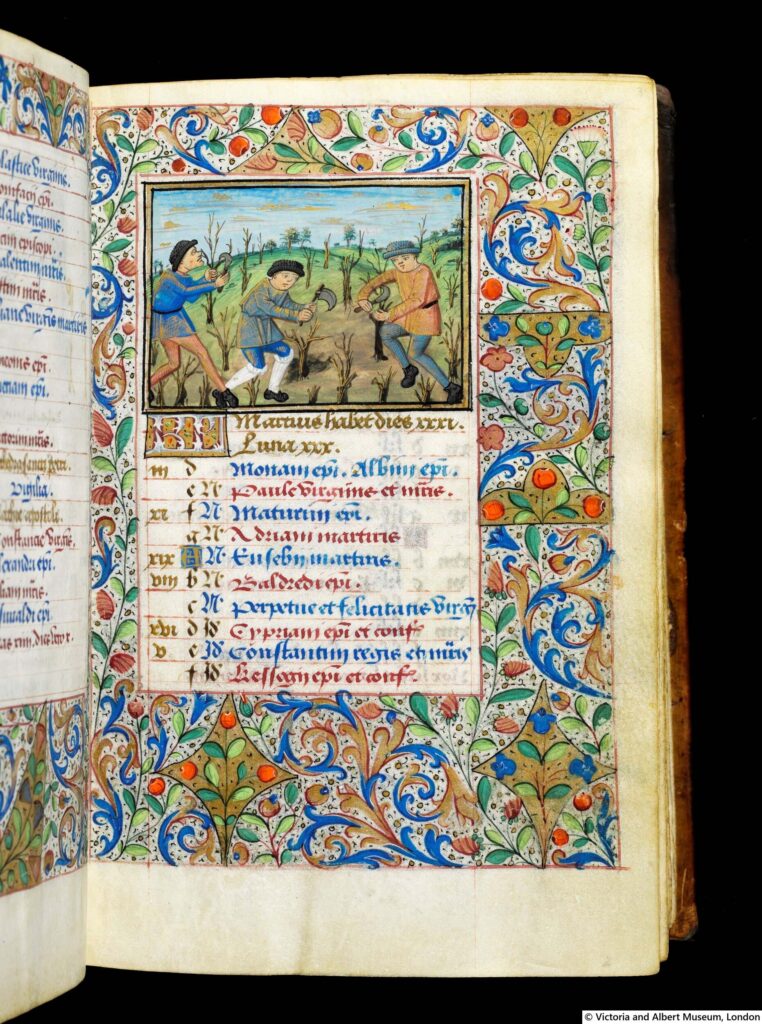
One such manuscript is part of the collection of the V&A in Dundee. It is known as the Playfair Book of Hours, as it was acquired around 1840 by the Playfair family of St Andrews. It dates from the 1480s and was produced in Rouen in Normandy. Its original owner is unknown, but one theory is that it could have been commissioned by a Scot living in France at the time as unusually St Monan, St Kentigern, and St Ninian, all Scottish saints, are mentioned in the calendar.
Each month of the calendar has a title illustration depicting some seasonal activity and is a charming insight into some aspect of late medieval life. These are activities that would be common and familiar throughout northern Europe and which we can imagine taking place here in Granton – although perhaps not treading the grapes……
See this beautiful book for yourselves at:
Book of Hours, The ‘Playfair Hours’ | V&A Explore The Collections